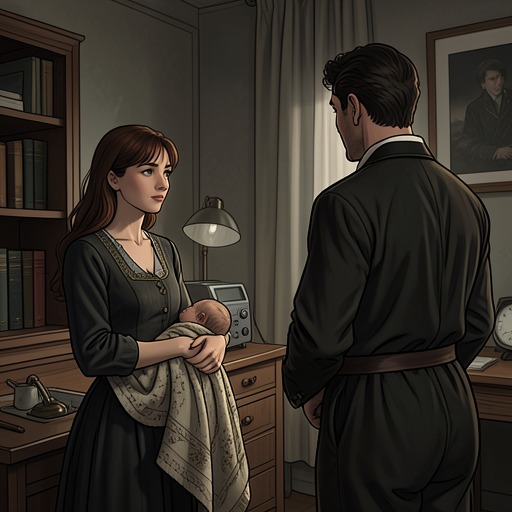
“For the sake of our child only”
The Beki CEO Got Me Pregnant“For the sake of our child only” is the defining expression of Yohan Xyle Laroses’s decision to marry Kazumi Lhynx Valeres after their unexpected pregnancy. It presents the marriage as an ethical commitment to their child rather than as proof of romantic desire, and it becomes a refrain through which the story separates sexual identity, gender expression, marital roles, and parental responsibility.
Meaning and Narrative Context
The expression arises from Yohan’s conflict between his established identity and the obligations created by pregnancy. From the beginning, Kazumi identifies Yohan as gay and describes him as feminine in manner and self-presentation, while also noting that he is her employer and her longtime best friend. His marriage to Kazumi therefore appears, on the surface, to contradict the identity that the narrative has already made explicit. Yohan resolves that contradiction by framing the wedding not as a change in orientation but as a decision to accept responsibility for the child.
Yohan’s internal decision is stated plainly: “I will marry Kazumi for the sake of our child.” The wording is deliberately narrow. It does not claim that love has suddenly replaced his gay identity, nor does it present marriage as a conventional romantic culmination. Instead, it defines the proposed union through a future child’s welfare and through the duties of an adult who refuses to abandon those duties.
Repetition and Dramatic Use
The phrase first functions as Yohan’s private rationale and then becomes a practical instruction to the people helping him plan the proposal. In a group chat that excludes Kazumi, he asks his workers for assistance because he intends to propose “for the sake of our child only.” The addition of “only” makes the claim emphatic, almost defensive. Yohan is not merely explaining the proposal; he is setting a boundary around its meaning before anyone can interpret it as a confession of romantic love.
The phrase also creates dramatic irony. Kazumi does not know why Yohan proposes so suddenly, and she interprets the proposal as possible evidence that he loves her. When she asks about his reason, Yohan denies that romantic explanation. His answer is that he wants to protect their child from confusion in the future, particularly from wondering about unfamiliar partners, and that marriage will allow him to uphold his responsibility as a parent. His joking insistence on calling himself “mom” softens the conversation, but it does not erase the wound caused by the clarification: Kazumi had hoped the proposal meant something more intimate.
Marriage, Parenthood, and Gendered Roles
At the wedding, the expression is translated into ceremony. Kazumi is asked to take Yohan as her lawful husband, and she accepts him in the language of marital fidelity, promising to be true, to love, and to honour him. The formal vows therefore introduce a vocabulary broader and more romantic than Yohan’s original justification. The ceremony establishes the legal and social fact of marriage even though Yohan’s stated motive remains parental responsibility rather than romantic love.
Yohan later gives the same explanation when questioned about why a gay man married a woman. He says that he did not marry Kazumi because he loved her, but because he was standing by his responsibility as a soon-to-be mother. This answer makes the expression a public defense of his conduct. He rejects the assumption that a heterosexual marriage must prove heterosexual desire, and he also rejects the idea that preserving his image requires him to hide the reason for the marriage. In his account, responsibility is sufficient justification.
The wording unsettles conventional categories without removing them. Yohan is addressed as a husband in the ceremony, calls himself a mother in his explanation, and is later introduced in the hospital as Kazumi’s husband and a parent of the newborn. These titles coexist with his continuing gay identity and feminine presentation. The expression consequently marks a separation between the role Yohan performs within family and law and the desire or identity that defines him personally.
Consequences and Later Reinterpretation
The phrase initially produces an unequal emotional situation. Yohan treats the marriage as a protective structure for their child, while Kazumi hears the proposal through the possibility of romantic recognition. Her disappointment shows that a responsible action can carry meanings different from the intention of the person performing it. The marriage may be ethically serious without being romantically motivated, and the expression preserves that distinction instead of allowing the wedding to settle into a simple love-story explanation.
Parenthood gives the phrase its concrete consequence. After the birth, Yohan receives the baby from the nurse, who addresses both adults as Mr. and Mrs. Laroses. The child’s arrival confirms the responsibility that had previously been anticipated in the proposal and wedding. The expression thus moves from promise to social reality: Yohan’s stated reason for marrying becomes attached to an actual family unit and to the continuing presence of their child.
Ten years later, the narrative still does not reduce Yohan’s life to the original justification. He remains committed to feminine clothing, makeup, and beautification, although his planned sex-change procedure and the removal of his penis never take place. Their child accepts this self-expression as Yohan’s way of being true to himself. In that later context, “For the sake of our child only” remains important because it records the origin of the marriage, but it does not exhaust the family’s identity or explain every form of intimacy that develops afterward.
Thematic Significance
As an expression, “For the sake of our child only” condenses the story’s argument that identity, love, marriage, and parenthood cannot always be treated as interchangeable. Yohan’s gay identity remains visible; his gender expression remains feminine; his legal role becomes Kazumi’s husband; and his central justification is the welfare of their child. The repeated phrase holds these facts together without pretending that they form a conventional romantic arrangement.
Its strongest effect comes from the tension between logos and pathos. Yohan’s reasoning is practical and future-oriented: marriage will provide a recognizable family structure and prevent the child from being confused by unfamiliar partners. Kazumi’s response is emotional because she had attached romantic hope to the proposal. The phrase is therefore both a logical explanation and an instrument of emotional distance. It protects Yohan’s stated identity while forcing Kazumi to confront the limits of what the proposal promises.
The expression also becomes a compact statement of chosen responsibility. Yohan does not claim that the pregnancy transforms him into someone else. He chooses to enter marriage because he believes the child should not bear the consequences of adult uncertainty. The story later complicates that initial “only” through the endurance of the household, the birth of the child, and the family’s acceptance of Yohan’s self-expression, but the phrase remains the key reminder that the marriage began as an act of responsibility before it could be understood as anything more.